The Pharmaceutical Duel: Australia vs. Africa
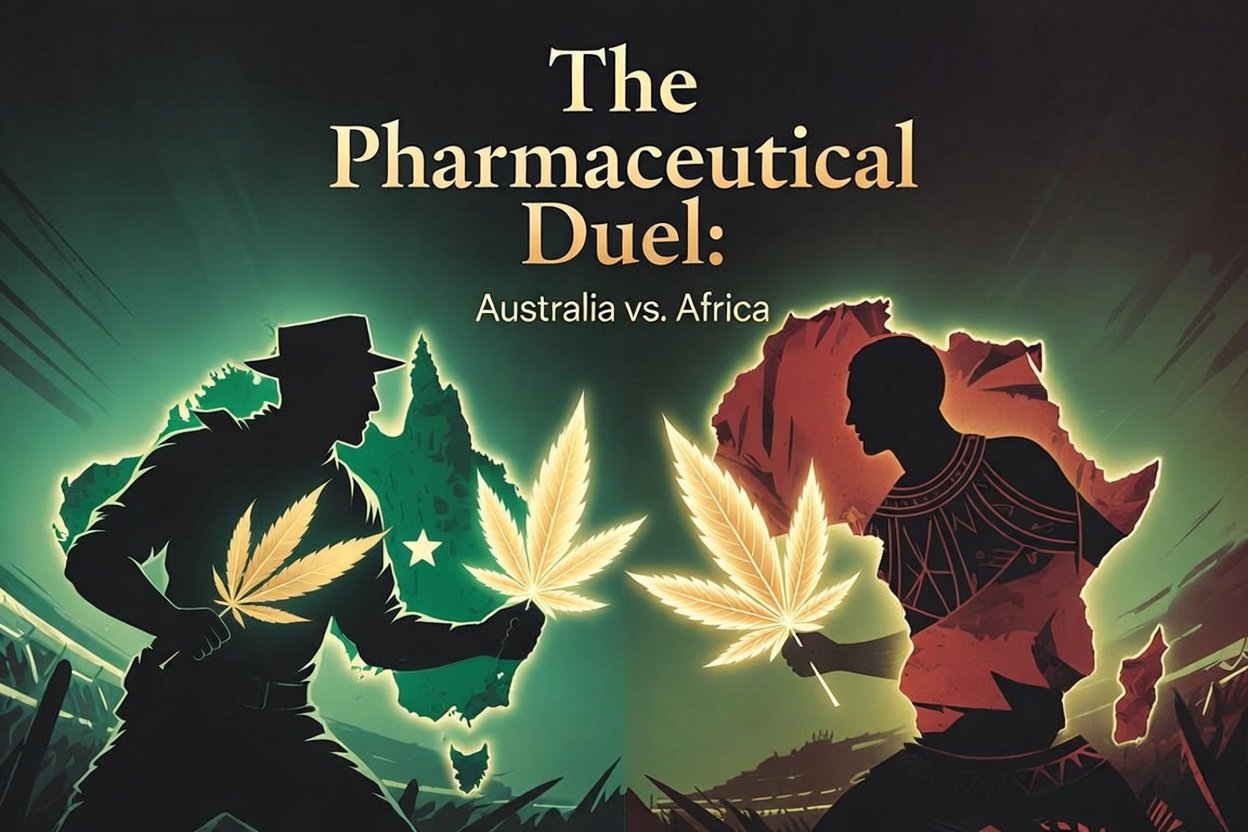
The Battle for the European Market: Laboratory Assembly Line vs. Natural Margin
A major geopolitical duel is unfolding in the global medical cannabis market. Two entirely different economic models are competing for dominance in the planet’s most lucrative and strictly regulated markets – primarily Germany, the United Kingdom, and Israel. On one side stands Australia: a triumph of high-tech corporate capital and sterile indoor cultivation. On the other are the emerging markets of Africa (Lesotho, South Africa, Uganda), betting on unmatched natural climatic advantages and low production costs. Both sides build their success on strict compliance with international law, yet the domestic price of this export expansion differs fundamentally for each society.
Technological Superiority vs. The Power of Nature
Australia’s economic strategy is anchored in uncompromising quality and standardisation. Lacking the capability for low-cost, year-round outdoor cultivation due to rigid environmental and regulatory barriers, Australian producers invested heavily in closed, automated facilities.
The Australian Therapeutic Goods Administration (TGA) enforced strict GMP standards, turning cultivation into a fully fledged pharmaceutical operation where the plant’s chemical profile is calibrated with extraordinary precision. For conservative European distributors, particularly German pharmacies, the Australian standard has become synonymous with reliability: every batch is guaranteed to be identical to the last. Australia does not just export biomass; it sells a predictable, high-end, and safe medical product.
The African model responds to this challenge with competitive natural economics. Nations like Lesotho and South Africa possess ideal natural factors: year-round high-altitude sunshine, fertile lands, and a substantial pool of affordable labour. The production cost per gram of African raw material is several times lower than that of Australian indoor facilities.
Realising that European markets are closed to artisanal products, African exporters made a qualitative leap. By attracting foreign direct investment from Canada and Europe, hubs in Lesotho rapidly retrofitted their greenhouses to meet GACP and GMP standards. Africa proved that natural ultraviolet light and cheap land, when paired with the right technological oversight, can yield a product that satisfies the stringent requirements of European regulators.
A Shared Legal Framework – International Law as a Shield
Despite differences in climate and capital, both models share the same legal DNA – impeccable diplomatic obedience. Unlike Latin America, which chose open confrontation with the old system, Australia and Africa utilise the legal gateways left open by the relevant UN drug control conventions. While these conventions strictly forbid recreational trade, they provide a clear path for medical and scientific research programmes.
Australia used this to solidify its status as a reputable global supplier. African governments received much-needed diplomatic cover to attract international investment: expanding export plantations was no longer interpreted as condoning illicit trafficking.
The Great Domestic Paradox
The ultimate dividing line between Australia and Africa lies not in profit margins, but in the realm of internal social justice.
The Australian model is consistent. While establishing an export industry, Canberra simultaneously built a legal and accessible medical framework for its own citizens. Tens of thousands of Australian patients access medical cannabis domestically through authorised physicians. The system seeks a balance between external revenues and domestic public health.
The African model is built on a profound social paradox and regulatory dualism. A situation has emerged on the continent where tonnes of premium cannabis are grown behind the secured perimeters of high-tech complexes under the supervision of foreign managers, destined for pharmacies in Frankfurt and London. Yet outside these perimeters, local law enforcement continues to prosecute, arrest, and imprison their own citizens for possession and use of the exact same plant. The crop has essentially become a 21st-century colonial commodity: cultivated exclusively for wealthy Western consumers while remaining a strict criminal taboo for the local population.
Who Will Secure the European Hub?
This duel demonstrates two alternative perspectives on global pragmatism:
Australia bets on predictability, capital, hyper-strict internal controls, and the integration of the patient into a legal system. Its vulnerabilities include high infrastructure costs and heavy energy expenditure required to maintain automated indoor facilities.
Africa wins on sunshine, cheap land, and massive scalability potential. Its primary risks stem from infrastructure instability, bureaucracy, and the ethical tension caused by maintaining a strict domestic ban alongside large-scale foreign export.
As price competition intensifies in EU markets, African producers who master GMP standards will inevitably squeeze Australian indoor operations out of the mass-market raw materials segment. However, Australia is likely to retain its leadership position in unique, highly standardised genetic strains and finished pharmaceutical forms. The battle for European pharmacies continues, and it will be won by the side that can offer the perfect equilibrium between laboratory sterility and nature’s affordability.