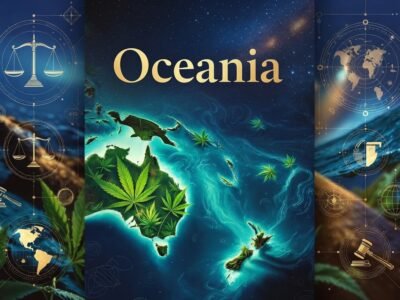
Analytical Duel: Oceania’s Legal Obedience vs. Latin America’s Constitutional Defiance

Two Poles of Drug Policy: Sovereign Pragmatism vs. Human Rights Ideology
The global landscape of cannabis reform is fractured into two fundamentally opposing legal doctrines. At one pole lies Latin America – the epicenter of “constitutional defiance” where the dismantling of prohibitive barriers is driven by judicial activism, supreme court rulings, and appeals to fundamental human rights. At the other stands Oceania (Australia and New Zealand), embodying “legal obedience”: here, reform progresses exclusively within a strict technocratic framework, biopharmaceutical standards, and absolute diplomatic adherence to international drug control conventions. This analytical duel demonstrates how two macro-regions tackle the exact same challenge – modernising outdated legislation – using diametrically opposed methods.
Sources of Legitimacy: Human Rights vs. Medical Necessity
The primary divergence between the two regions lies in the socio-political foundation of their reforms.
In Latin America, the driving force behind change has been civic activism, judicial precedents, and the concept of human rights. Mexico, Colombia, and Argentina pursued a path of judicial activism. The supreme courts of these nations sequentially recognised criminal prosecution for cannabis consumption as a violation of an inherent constitutional right to the “free development of one’s personality.” Latin American modernization is, first and foremost, a decriminalization of the consumer – a human rights manifesto and an attempt to tear society away from the destructive “war on drugs.” In this paradigm, international obligations recede before the domestic constitutional right to human dignity.
Oceania has completely depoliticised this process. In Australia and New Zealand, reform did not begin in human rights courtrooms, but in medical laboratories and regulatory offices. The core of Oceania’s reform became the concept of harm reduction and evidence-based medicine. Access to cannabis here is viewed not as a civil right, but as a strictly monitored therapeutic necessity. Australia’s Therapeutic Goods Administration (TGA) integrated cannabis into the healthcare system as a high-tech pharmaceutical product. A citizen of Oceania obtains cannabis not because they are free to make that choice, but because their treating physician issued a prescription meeting rigid GMP standards.
International Law: Direct Defiance vs. Evolution Within the Rules
Attitudes toward the global drug control architecture definitively split these regions into different geopolitical camps. Latin America chose a path of open challenge or intricate legal manoeuvring.
- In 2013, Uruguay became the first state to establish a regulated commercial market despite international prohibitions, consciously entering a diplomatic conflict with the International Narcotics Control Board (INCB).
- Other countries in the region rely on domestic judicial doctrines, effectively bypassing international agreements to protect national sovereignty and citizens’ rights.
Oceania, conversely, elevated compliance with international treaties to an absolute priority. Canberra and Wellington build their regulatory models so that no objections can be raised against them on the global stage. They utilise the legal window left by the relevant UN drug control conventions, which permit the circulation of cannabis exclusively for medical and scientific purposes. Even when the Australian Capital Territory decriminalised personal possession, a commercial market was strictly forbidden precisely to avoid violating the spirit of the global conventions. Oceania proves that modernization does not require diplomatic confrontation – it can be achieved through meticulous adherence to the letter of the law.
Market Architecture: Economic Inclusivity vs. Corporate High-Tech
The methodological divide also dictates the character of the emerging markets. The Latin American model of commercialisation is oriented toward social inclusivity and the agrarian sector. In Colombia and Uruguay, laws include quotas for small-scale farmers and indigenous communities affected by drug conflicts, attempting to transform cannabis into a tool for poverty reduction. However, this sector suffers from bureaucratic complexity, a lack of banking services, and regulatory instability. The Latin American market represents a massive potential trapped in the jaws of economic uncertainty.
The market in Oceania is a high-tech industry backed by substantial corporate capitalisation. Australia gambled on creating a premium export hub. The industry is controlled by biopharmaceutical corporations capable of funding expensive state licences and rigorous scientific research. Thanks to an impeccable international legal reputation, Australian companies exploit global supply chains with relative ease, exporting certified raw materials to Germany, the United Kingdom, and Asian nations. Latin America trades in ideology and accessible biomass; Oceania trades in high technologies and standardised molecules.
What Lessons Do These Regions Offer the World?
Both approaches carry critical vulnerabilities. Latin America’s “defiance” struggles with institutional weakness: judicial rulings often outpace the state’s capacity to build a functioning economic infrastructure, leaving grey zones for the illicit market to exploit. Oceania’s “obedience” suffers from excessive conservatism: the rigid boundaries of the relevant UN conventions and a profound fear of recreational legalization stifle the development of the domestic market and create legal anomalies, such as prosecuting medical patients for driving with legally prescribed treatments.
Nevertheless, this duel highlights a vital geopolitical lesson: there is no universal recipe for drug policy reform.
- If a state needs to resolve a deep-seated social crisis, defend human rights, and reduce criminal violence, its path points toward the Latin American constitutional route.
- If the objective is to develop innovative medicine, attract large-scale capital, and integrate into global legal trade without losing diplomatic face, the Oceania strategy becomes the ideal choice.
The world stands divided: a revolutionary defiance challenges the old order, while a technological evolution reshapes it from within. The outcome of this friction will define the contours of international law for decades to come.