The American Grotesque: A Patchwork of Freedom and Prohibition on Washington’s Chessboard
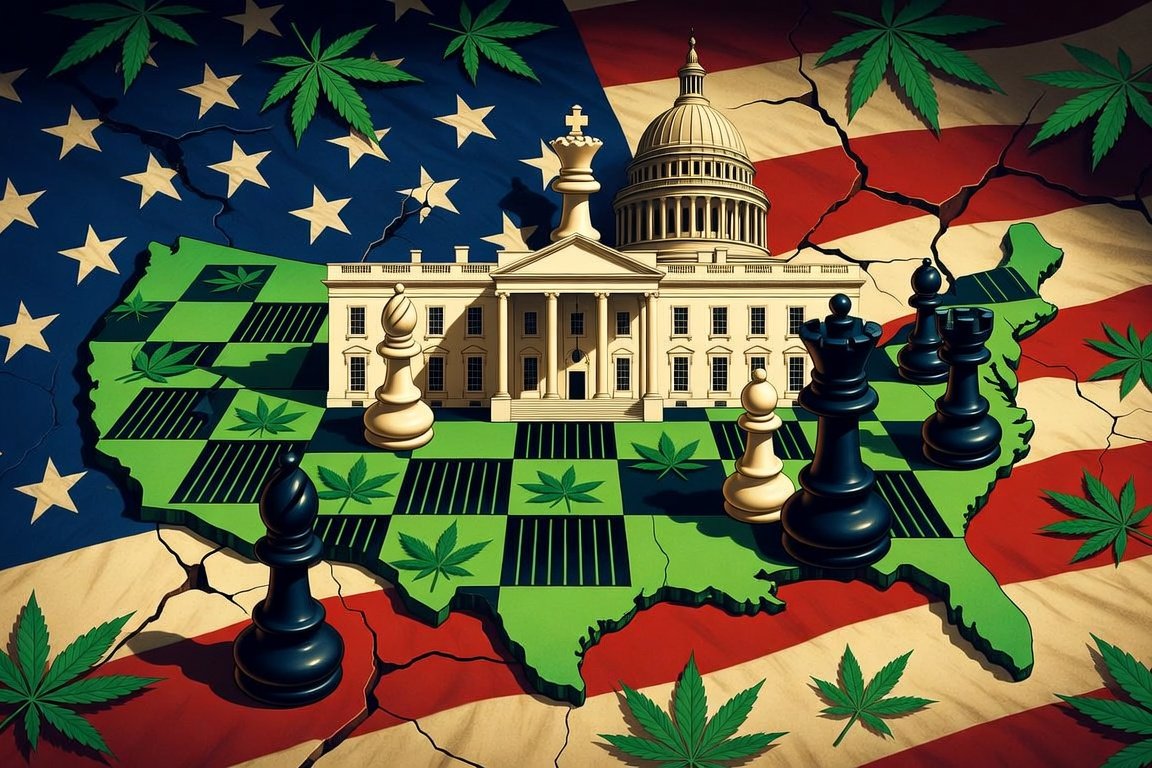
A Nation of Two Realities: Between the Federal Noose and State Sovereignty
The United States has engineered the most paradoxical, contradictory, and deeply schizophrenic cannabis system on the planet. To step onto American soil is to navigate two parallel universes at once: de jure, the plant remains under an absolute federal ban; de facto, it is legally displayed and sold in gleaming, high-end boutiques across half the country.
This legal grotesque is no accidental oversight. It is the direct result of a collision between geopolitics and the unique architecture of American governance. On one side stands the UN Single Convention on Narcotic Drugs of 1961, which obligates Washington to criminalize the trade. On the other is the federal Controlled Substances Act (CSA) of 1970, which classifies cannabis as a Schedule I drug, placing it on the same legal shelf as heroin. Wedged right in the middle is the US Constitution, which grants individual states the sovereign right to regulate public health and safety within their borders.
The result is a spectacular paradox: you can walk into a storefront in Denver and legally purchase a gram of cannabis, only to automatically become a federal criminal the moment you step through the security gates of the local airport.
The Federal Anchor: The Controlled Substances Act as Frozen Dogma
The primary anchor dragging down national reform is the CSA. Passed over half a century ago, this statute locked cannabis into Schedule I – a category reserved for substances officially deemed to have:
- No currently accepted medical use
- A high potential for abuse
- A total lack of accepted safety parameters, even under strict medical supervision
While this classification is scientifically obsolete, it remains legally ironclad. It is the ultimate source of the industry’s quasi-legal limbo, blocking cannabis businesses from accessing standard corporate banking, forbidding commerce across state lines, and forcing a multi-billion-dollar legal market to operate predominantly in cash.
50 Laboratories of Democracy: America’s Patchwork Quilt
Yet while Washington pretends the market does not exist, individual states have brilliantly played their ultimate constitutional trump card: the principle of federalism. They have transformed themselves into what Supreme Court Justice Louis Brandeis once famously termed “laboratories of democracy” – autonomous testing grounds where each region conducts its own massive socio-economic experiment.
Rather than a unified national policy, America has evolved into a striking, almost chaotic patchwork quilt of local laws. On one end of this legal spectrum lies total liberation. States like Colorado, California, Michigan, and New York have thrown their doors wide open to recreational use, turning cannabis into a highly sophisticated commercial industry defined by lifestyle brands, corporate investments, and substantial tax revenues.
Occupying the middle ground is a massive medical compromise that now unites more than 35 states. Remarkably, this model has found its most dynamic footing in deeply conservative regions like Florida and Mississippi. Here, local governments fiercely reject recreational sales, yet have methodically built large networks of medical dispensaries to serve registered patients.
Meanwhile, on the opposite side of the barricades, the walls of total prohibition still stand tall. In states like Idaho, Kansas, and South Carolina, absolute zero tolerance remains the law of the land, and the criminal justice system continues to police the plant using the punitive strategies of the previous century.
These sharp contrasts create astonishing geographic collisions. Conservative Florida generates billions in revenue from medical licences, progressive New York has navigated significant bureaucratic and judicial disputes over regulating its liberal retail sector, and neighbouring Kansas continues to prosecute citizens for possessing a fraction of an ounce.
Why the Federal Centre Blinks
The federal government has not surrendered – it has executed a diplomatic retreat through a strategy known as “prosecutorial discretion.”
First, the landmark Cole Memorandum (2013) instructed federal prosecutors to deprioritize state-legal cannabis businesses that were well-regulated. Second, Congress has consistently passed budget riders that explicitly forbid federal agencies from spending taxpayer dollars to interfere with state-level medical programmes.
Beneath it all lies a raw political reality: public support for cannabis legalization has remained a consistent majority of Americans for over a decade, ranging from around 64% to a peak of 70% in recent years.
Editorial note: At the time this chapter was written, polling by Gallup showed public support at 68-70%. The most recent Gallup data (November 2025) places the figure at 64%, reflecting a notable drop in Republican support under the current political climate. The broader trend of sustained majority support remains accurate.
It is a fragile, unspoken truce where the legacy law remains unchanged, but the federal war axe remains buried in the drawer.
The Invisible Treaty Hand
The United States cannot easily dismantle federal prohibition without confronting its international obligations. Unlike Canada or Uruguay, which openly accepted diplomatic friction with UN drug control treaties, Washington places immense geopolitical value on the global prohibition architecture – an architecture it largely designed and enforced throughout the 20th century.
Yet in 2020, a quiet coup unfolded on the international stage. The historic UN vote knocked out the primary scientific pillar supporting the US Controlled Substances Act, handing domestic reformers a potent legal instrument for future battles in federal courts.
On the Verge of an Earthquake: Rescheduling and Interstate Commerce
America stands on the precipice of its largest legal and economic disruption since the repeal of Prohibition. The administratively driven review to shift cannabis to the less restrictive Schedule III has the potential to rewrite the rules of an entire industry.
The most explosive consequence of federal rescheduling would be the birth of interstate commerce. The moment state borders fall, the economic landscape will transform overnight. Highly isolated, high-cost local markets will buckle under the weight of cheaper cannabis shipped from legacy agricultural hubs like California and Oregon. National supply chains will materialize, and federal agencies including the FDA and ATF will step in to regulate the space. The industry will transform into a standard, institutionalized American corporate sector.
Why the American Chaos Governs the Global Debate
The US was not the first nation to dismantle prohibition, but its market possesses a massive gravitational pull that shapes policy across the globe:
- Latin America (Mexico, Colombia, Brazil): Jurisprudence and legislative debates frequently use US state data as primary arguments for constitutional court rulings regarding human rights and personal autonomy.
- An Economic Magnet for Africa: Nations like Lesotho and Zimbabwe are rewriting their agricultural laws and constructing medical cultivation facilities, targeting exports at premium demand across the Atlantic.
- Europe and Asia: From Germany’s CanG model to Thailand’s shifting regulations and South Korea’s strict medical frameworks, international policymakers rely heavily on clinical, economic, and public-safety datasets generated by American states over more than a decade of legalization.
America did not provide the world with a flawless blueprint; it provided a priceless macroeconomic test site. It showed global governments exactly how taxes behave, how public health responds, and how organized crime retreats when a forbidden substance is successfully integrated into a regulated, state-monitored tax structure.
Epilogue: A Fragile Equilibrium
The United States has not resolved the cannabis question; it has simply split it down the middle. It has managed to pack fierce prohibition and substantial liberty, respect for legacy international treaties, and the raw pressure of grassroots democracy into the borders of a single nation.
This American puzzle is volatile, heavily shaped by partisan politics, and in constant motion. Yet that is precisely why it remains the most influential socio-cultural and economic experiment of our time. The delicate balance between the federal “no” and the local “yes” cannot hold forever. The rest of the world watches, waiting to see which half of this massive legal architecture will ultimately bring the other down.