The European Puzzle: Regulation, Reform, and the Iron Curtain of Treaties
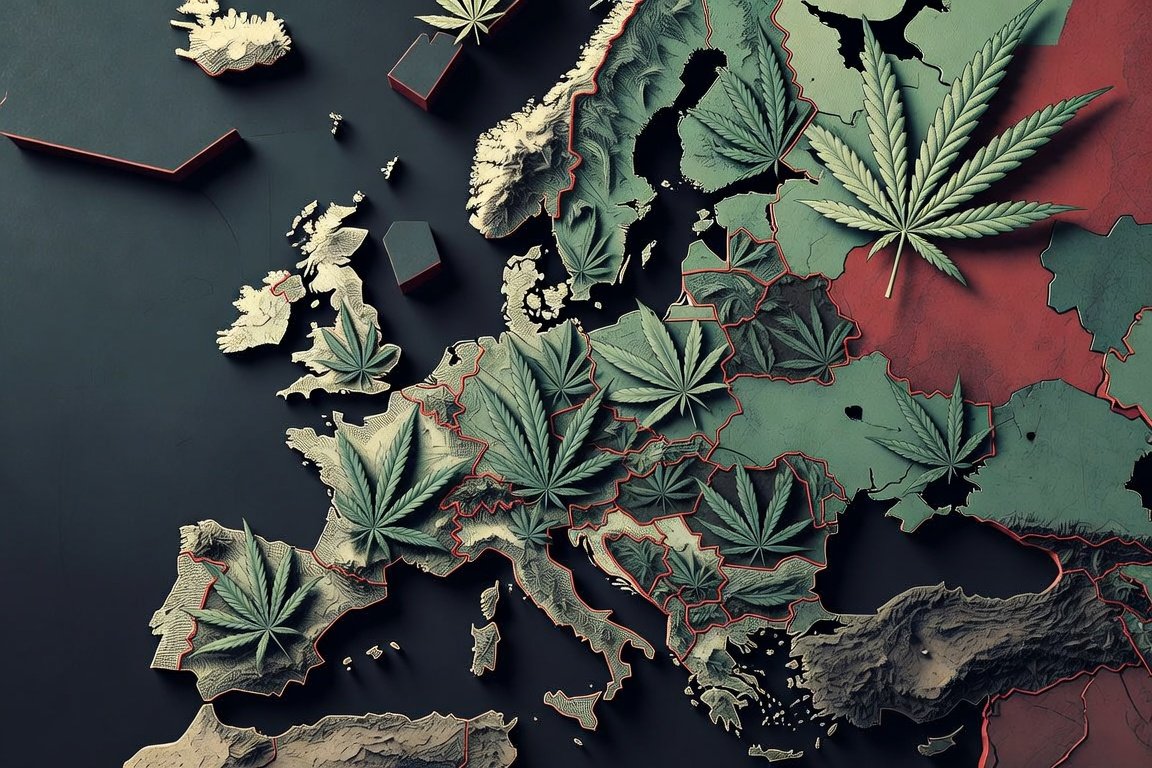
A Continent at a Crossroads: Between Legacy Treaties and Modern Realities
Europe’s cannabis landscape is a complex legal mosaic squeezed between three powerful forces: rigid UN drug control treaties, the bureaucratic constraints of the European Union, and the sovereign political identities of 27 member states.
While the 1961 UN Single Convention on Narcotic Drugs still classifies cannabis as a strictly controlled substance, European capitals have begun to reinterpret and test the limits of these rules. This has exposed a deep ideological divide. While some nations view the plant through the lens of public health, others treat it as a strict criminal threat. The game of legalization in Europe is being played on the exact same field, but by completely different rules.
Any step taken by a European reformer is not just a simple domestic legislative amendment – it is a highly sensitive diplomatic manoeuvre within an entrenched global system.
The Pioneers: Legalization Without Commercialism
Germany’s CanG: A Masterclass in Legal Diplomacy
In 2024, Germany enacted its landmark Cannabis Act (CanG), creating the most significant policy precedent in modern European history. Berlin wanted reform but was constrained by the prospect of violating international law. The result was a calculated compromise: the country legalized possession, home cultivation, and non-commercial cannabis social clubs, but deliberately stopped short of establishing an open commercial market.
Germany’s legal argument was precise: the non-commercial model serves strictly to protect public health and eradicate the black market, thereby respecting the underlying intent of the 1961 Convention.
The Maltese Precedent: The Silent First
Malta beat Germany to the punch, becoming the first EU member state to legalize adult-use cannabis in 2021. Its system stands on three non-commercial pillars: non-profit associations, limited personal cultivation, and a total ban on advertising. Malta proved that a nation can advance social justice without triggering major international standoffs.
The Laboratory of Compromise: Luxembourg, Switzerland, and Czechia
Europe’s middle-path countries have turned their territories into legal and scientific testing grounds:
- Luxembourg (2023): Legalized personal cultivation at home while blocking commercial retail sales entirely.
- Switzerland: Utilized a specific legal window in the 1961 Convention that permits handling restricted substances for “scientific research,” launching tightly monitored pilot sales programmes across major cities.
- The Czech Republic: Is developing a regulatory framework closely aligned with Germany’s public-health-focused, non-commercial approach.
The Fractured Continent: The Orthodox Bloc of Resistance
Europe is far from moving in lockstep. The continent is defined by a profound conflict between two opposing political philosophies. On one side stands a progressive alliance led by Germany, Malta, and the Czech Republic. On the other sits a resistance bloc that views liberal reforms as a threat to national security, social order, and traditional values.
This divide is particularly visible in France. Despite having some of the highest cannabis consumption rates in Europe, France maintains some of the harshest criminal penalties for recreational use in the EU.
Further north, Sweden and Finland champion strict zero tolerance. In Finland, even growing parliamentary pressure has so far failed to shift a rigid political consensus. Across Eastern Europe, the majority of states continue to classify cannabis as a national security and law-enforcement issue, resisting a pivot toward harm reduction.
The 2020 Tectonic Shift and the Medical Consensus
On December 2, 2020, the UN Commission on Narcotic Drugs voted to remove cannabis from Schedule IV. While not a green light for recreational dispensaries, it served as an official acknowledgment of the plant’s therapeutic value. For European governments, this vote transformed medical cannabis programmes from a rebellious policy experiment into a legitimate, institutionalized component of public health systems.
| Country | Recreational Status | Medical Cannabis Status | Cross-Border Movement (Schengen) |
|---|---|---|---|
| Germany | Legalized (non-commercial clubs) | Authorized (widely accessible) | See note below |
| Poland | Strictly prohibited | Authorized (rapidly growing market) | Requires a Schengen Certificate |
| France | Criminal prosecution | Highly restricted pilot programmes | Under strict regulatory lock |
| Sweden | Zero tolerance | Extremely limited access | Exceptional circumstances only |
Note on Germany and the Schengen Certificate: Since April 2024, Germany reclassified medical cannabis as no longer a narcotic domestically, which means German authorities may not issue an Article 75 Schengen Certificate for outbound travel. However, destination countries’ own requirements still apply. German patients travelling within the Schengen Area should verify the specific rules of their destination country and carry a medical prescription and documentation regardless.
Medical cannabis has become the quiet diplomatic bridge allowing even the most conservative nations to modernize their healthcare frameworks without formally tearing up legacy international treaties.
Why Europe’s Fragmented Strategy Matters to the World
Europe is proving to the global community that Canada’s path of corporate commercialism is not the only viable blueprint:
- Flexibility Within the Law: European reformers have demonstrated how old international treaties can be reinterpreted from within, rather than aggressively abandoned.
- Legalization Without Corporate Giants: The Maltese and German models show that an underground market can be dismantled without handing control to transnational corporations.
- A Blueprint for Incrementalism: Governments across Latin America, Africa, and Asia are studying Europe’s cautious, incremental strategies as an alternative to rapid market deregulation.
Epilogue: A Puzzle Not Meant to be Solved
The true uniqueness of the European landscape is that there is no singular endpoint. The continent is not trying to force its pieces into a uniform picture.
Europe is the puzzle. It is a space where the immediate border-to-border proximity of a conservative Sweden and a reformist Germany forces the rest of the world to watch. As legacy international treaties fracture under the pressure of science and pragmatism, Europe continues to rearrange its pieces – quietly drafting new rules of engagement for the 21st century.