The Global Legal Map: How Cannabis Laws Differ Around the World
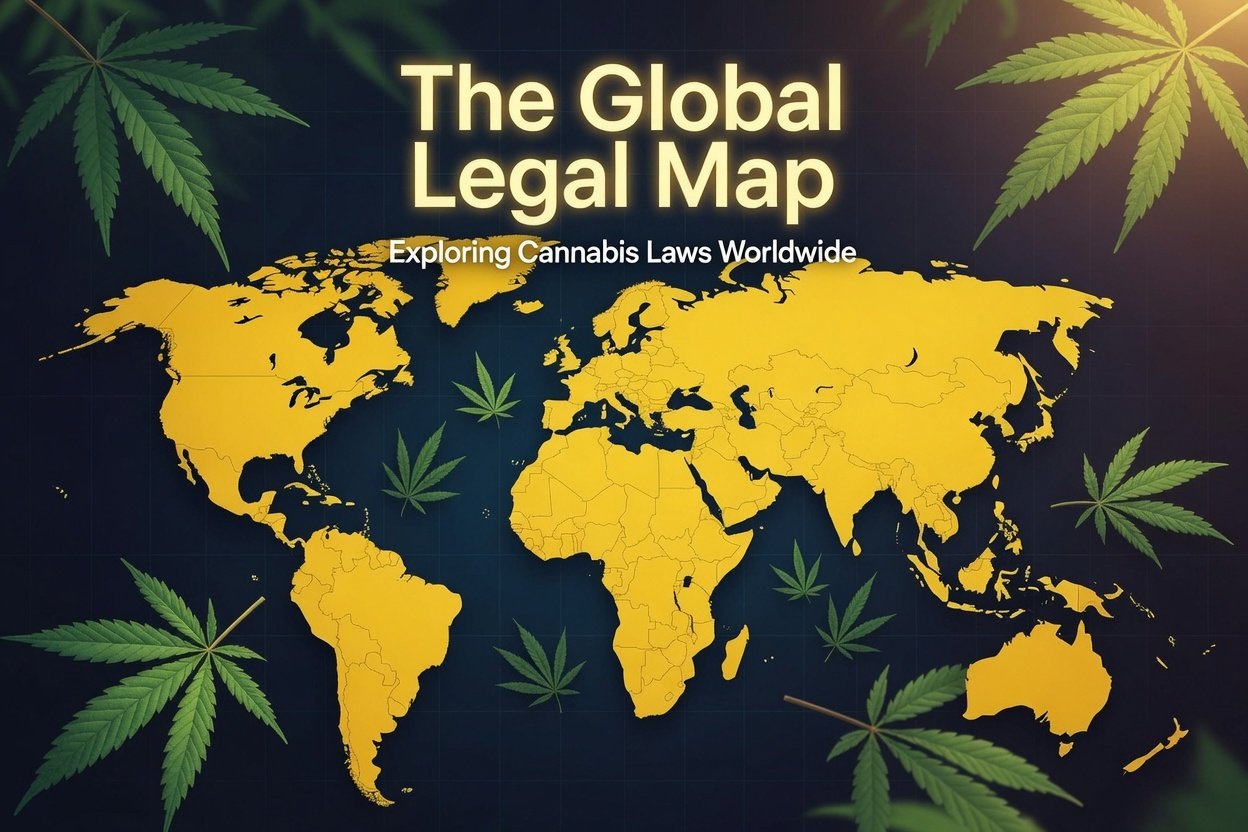
A sweep across borders, ideologies, and the quiet revolution reshaping the meaning of a plant.
I. The World Before Legalization: Fear, Myth, and the Machinery of Control
For most of the twentieth century, cannabis lived inside a fortress built from treaties, fears, and political imagination. The 1961 UN Single Convention on Narcotic Drugs cast a long shadow, placing cannabis in the same punitive schedules as heroin and opium. It was a classification born not from science, but from geopolitics – a Cold War-era moral architecture that treated the plant as a global threat.
A Story from the Age of Prohibition
Consider the United States in the 1930s, where Reefer Madness turned cannabis into a cinematic villain, or Mexico, where “marihuana” became a political weapon. Decades later, research published in The Lancet, JAMA Psychiatry, and NEJM would dismantle these myths, showing that the fear was cultural, not clinical.
Yet laws persisted. Cannabis became a symbol of deviance, even as communities quietly preserved it: Rastafarian rituals in Jamaica, bhang traditions in India, hashish traditions in Morocco. The law said one thing; culture whispered another.
II. The Modern Legal Landscape: A Patchwork of Progress and Paradox
Today, cannabis legality is not a single global narrative – it is a mosaic. Some nations embrace full legalization, others cling to prohibition, and many hover in the liminal space of medical-only frameworks. Geography determines legality more than science ever did.
North America: The Laboratory of Legalization
The United States is a paradox. Cannabis remains federally illegal, yet dozens of states have legalized it for medical or recreational use. This creates a surreal duality: a dispensary can operate legally under state law while violating federal law simultaneously. Reports from NIDA and NEJM highlight how this tension obstructs research, banking, and interstate commerce.
Canada, meanwhile, legalized cannabis nationally in 2018, becoming the first G7 nation to regulate it like alcohol. Its model – federal backbone, provincial nuance – is now quietly studied by policymakers worldwide.
Europe: A Continent of Cautious Reform
Europe moves slowly, but deliberately. Germany’s 2024 legalization marks a historic shift, signalling that the EU’s largest economy is ready to rethink decades of prohibition. Portugal’s 2001 decriminalization remains a public health success story praised by the WHO and AJPH.
The Netherlands, long mythologized as a cannabis utopia, is more complex. Coffeeshops are tolerated, but large-scale cultivation remains illegal – a “backdoor problem” where legal retail depends on illegal supply. France, Italy, and Spain hover between medical access and cultural tolerance, each with its own contradictions.
Asia: Tradition Meets Restriction
Asia is a continent of contrasts. Thailand shocked the world in 2022 by removing cannabis from its narcotics list, blending ancient herbal traditions with modern policy – though re-regulation began in 2024-2025. Japan and South Korea maintain strict prohibition, shaped by post-war conservatism. India’s relationship with cannabis is ancient – bhang is legal in many states – yet modern laws remain restrictive, a colonial legacy rather than a cultural truth.
Africa and the Middle East: Emerging Markets and Old Taboos
South Africa legalized personal cultivation after a landmark constitutional ruling. Morocco, one of the world’s largest hashish producers, moved cautiously toward medical legalization in 2021. Lebanon’s 2020 medical reform signalled a potential shift in the region.
III. The Forces Behind Legal Change: Science, Culture, and the Politics of Pain
Legalization is never just about the plant. It is about the forces that shape societies: science, economics, public health, and cultural identity.
Science as a Catalyst
Modern research – from Lancet Psychiatry to NEJM – reframed cannabis as a pharmacological tool rather than a moral threat. Studies on chronic pain, epilepsy, PTSD, and inflammation pushed governments to reconsider outdated laws. WADA removed CBD from its prohibited substances list in 2018, though THC remains banned in-competition – a distinction that reflects growing recognition of cannabis’s therapeutic potential alongside continued concern about performance fairness.
Culture as a Pressure Valve
Music, film, and digital media normalised cannabis faster than legislation ever could. From reggae to hip-hop, from counterculture cinema to wellness influencers, cannabis became a symbol of authenticity, creativity, and relief. Laws eventually followed culture – not the other way around.
Economics as the Deciding Factor
Legal markets generate billions. Tax revenue, job creation, agricultural innovation – these forces often persuade governments more effectively than scientific papers or social movements. Colorado’s cannabis tax revenue consistently surpassed its alcohol excise tax receipts within years of legalization – reaching over 280 million in cannabis taxes compared to around 56 million from alcohol in fiscal year 2022-23, though it should be noted Colorado’s alcohol excise taxes are among the lowest in the United States. Other jurisdictions took notice.
IV. Where Law Meets Life: Reform in Practice
Germany’s Quiet Revolution
In pharmacies and GP surgeries across Germany, elderly patients who once feared cannabis now access it as prescribed medicine. Germany’s 2017 medical programme and 2024 adult-use reform transformed the country from a prohibition holdout into one of Europe’s most significant cannabis markets.
Mexico’s Constitutional Awakening
Mexico’s Supreme Court ruled across multiple decisions that cannabis prohibition violated personal autonomy. The decisions were not about commerce; they were about dignity and constitutional rights.
South Africa’s Landmark Ruling
Following a Constitutional Court ruling that declared private use a human right, South African citizens gained the legal right to cultivate cannabis for personal use – one of the clearest examples on the continent of rights-based rather than commerce-driven reform.
The UN Moment That Shifted the Global Conversation
On 2 December 2020, the UN Commission on Narcotic Drugs voted to remove cannabis and cannabis resin from Schedule IV of the 1961 Convention – the category reserved for substances considered “particularly harmful and with limited medical value.” As the official press statement notes, *”The Commission decided by 27 votes to 25 to delete cannabis and cannabis resin from Schedule IV of the 1961 Convention.”*
It was a symbolic but historic shift: the world’s highest drug-policy body acknowledging that cannabis does not belong among the most dangerous substances. A small step, but a global signal.
Conclusion: A World in Transition, A Plant in Translation
The global legal map of cannabis is not a static chart – it is a living story. A story of nations wrestling with history, science, fear, and hope. A story of communities reclaiming traditions, patients seeking relief, and lawmakers navigating the tension between caution and progress.
Cannabis laws differ because cultures differ, histories differ, and fears differ. But the trajectory is unmistakable: the world is moving toward a future where cannabis is understood rather than feared, regulated rather than demonised, integrated rather than hidden.
The map is still being drawn. And for the first time in a century, it is being drawn in shades of green.