How Long Does Cannabis Stay in Your System?
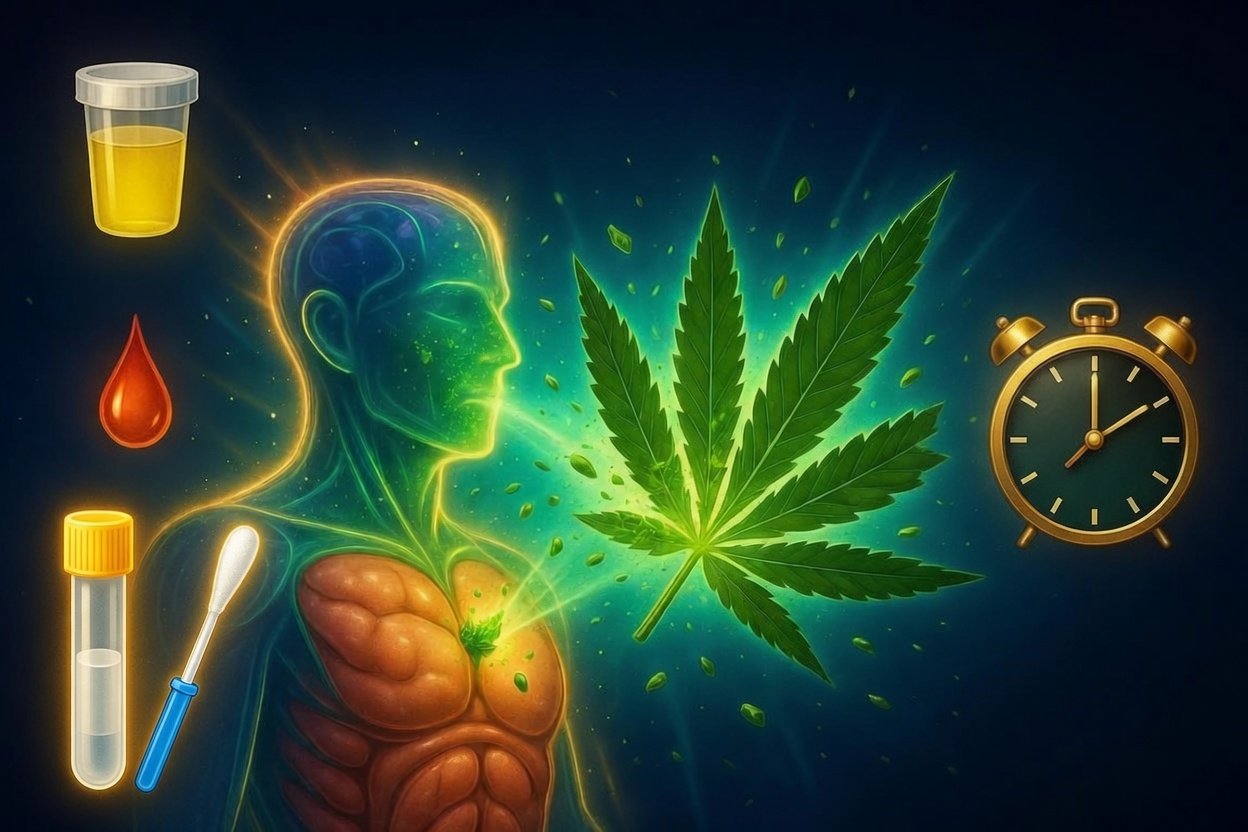
What drug tests actually measure, how long THC stays detectable in urine, blood, saliva, and hair – and why “detectable” is not the same as “impaired.”
The short version
Cannabis stays detectable far longer than it stays active. The “high” fades in hours, but the compound most drug tests look for can linger for days to weeks because it is stored in body fat and released slowly [3]. How long it remains detectable depends mostly on how often you use, plus your body composition, the dose, and – critically – which test is being run:
- Blood & saliva: hours to a day or two (recent use)
- Urine: a few days to ~30 days (sometimes longer in heavy chronic users)
- Hair: up to ~90 days
A positive result on a urine or hair test tells you cannabis was used at some point in the detection window. It does not mean a person is currently impaired – an important distinction we explain below.
What drug tests actually measure (and why detection ≠ impairment)
Most cannabis tests do not look for THC itself. They look for THC-COOH (11-nor-9-carboxy-THC), an inactive metabolite the body produces as it breaks THC down [1][3].
This matters because THC and THC-COOH behave very differently in the body:
- THC (the compound that gets you high) enters the blood within minutes of smoking, peaks fast, then drops sharply over the next few hours [4]. By the time the effects wear off, blood THC is usually already low.
- THC-COOH is highly fat-soluble. It accumulates in fatty tissue and diffuses back into the bloodstream slowly over days and weeks [3]. THC has even been detected in fat tissue weeks after last use [6].
Because of this, a test that screens for THC-COOH (urine, hair) can come back positive long after any impairing effect is gone. That is the single most misunderstood fact about cannabis testing – detectable is not the same as impaired – and it is why blood and oral-fluid tests, which target recent active THC, are the ones used for roadside and workplace impairment screening.
Detection windows by test type
Urine – the most common test
Urine testing is the standard method because it is cheap, non-invasive, and has the widest detection window [1][7]. It screens for THC-COOH.
How the test works (the part most articles skip): a standard immunoassay screen flags THC-COOH at a cutoff of 50 ng/mL. A positive screen is then confirmed by GC-MS or LC-MS/MS at a stricter 15 ng/mL cutoff [1]. This two-step design is why borderline results near the cutoff can flip depending on hydration and timing — a sample slightly above 50 ng/mL on the screen still has to clear confirmation.
Approximate detection windows by frequency (these are estimates – individual physiology varies widely) [1][2]:
| Use pattern | Approx. urine detection |
|---|---|
| Single / occasional use | ~1–3 days (can reach a week) |
| Moderate (a few times/week) | ~5–7 days |
| Daily use | ~10–15 days |
| Chronic heavy (multiple times/day) | 30+ days |
In long-term heavy users, positive urine results have been documented up to 46 days after stopping [2]. Higher body-fat percentage tends to extend these windows, because more THC-COOH is stored in fat [3].
Blood — short window, signals recent use
Blood tests detect active THC, not the long-lasting metabolite, so the window is short. THC peaks within minutes of smoking and falls sharply afterward [4].
- Occasional users: roughly 2–12 hours [3]
- Can extend to ~24 hours with higher doses
- Chronic heavy users: detectable for several days, as THC stored in fat re-enters circulation [3]
Because blood reflects recent active THC, it is the test most associated with impairment screening.
Saliva (oral fluid) – used for roadside screening
Oral-fluid tests detect THC deposited in the mouth from smoking or vaping, and are common in roadside and some workplace settings [5]. Typical window: up to ~24 hours, sometimes up to ~72 hours. Edibles are less reliably detected this way, because THC is swallowed and metabolized rather than lingering in the mouth.
Hair – the longest window, but it can’t tell you when
Hair testing detects THC-COOH that becomes incorporated into the hair shaft as it grows. The standard is a 1.5-inch sample, which covers roughly the most recent 90 days of growth [5].
Two caveats worth stating plainly:
- Hair testing shows that use occurred somewhere in that ~90-day window – it does not pinpoint when.
- It is more reliable for regular/heavy use than for light or one-off use, which may not register at all.
External contamination is possible but uncommon; standard lab procedures wash samples before testing to reduce false positives.
What actually affects your detection time
Detection windows are ranges, not guarantees. The main variables [1][3]:
- Frequency of use – by far the biggest factor. Occasional use clears quickly; chronic use builds up THC-COOH in fat.
- Body-fat percentage – more fat means more storage and slower release of a fat-soluble metabolite.
- Dose and potency – more THC in, longer to clear.
- Route of consumption – edibles are processed through the liver and produce longer-lasting metabolites; smoking/vaping peaks and declines faster.
- Metabolism and hydration – a faster metabolism clears faster; very dilute urine can lower the measured concentration (though labs flag obviously dilute samples).
Can you speed up THC elimination?
Short answer: not reliably. Time is the only dependable factor. A few popular methods don’t hold up:
- Drinking lots of water doesn’t pull THC-COOH out of fat. It can temporarily dilute urine, but labs check for and flag dilute specimens.
- Exercise can backfire. A controlled study found that 35 minutes of cycling produced a small but statistically significant rise in blood THC in regular users – exercise mobilizes fat stores and can release stored THC back into circulation [6]. Working out right before a test may raise your level, not lower it.
- Commercial “detox” kits are not supported by robust, peer-reviewed clinical evidence, and some carry their own health risks.
Does CBD show up on a drug test?
This is the question most relevant to anyone using CBD products – and the answer is more nuanced than “no.”
Drug tests screen for THC-COOH, not CBD [1]. Pure CBD, on its own, will not trigger a positive. But the risk depends entirely on what’s actually in your product:
- Full-spectrum CBD legally contains trace THC (in the US, up to 0.3% by dry weight). Regular or high-dose use of a full-spectrum product can accumulate enough THC-COOH to cross the 50 ng/mL screening cutoff and produce a positive [1].
- Broad-spectrum CBD has had THC largely removed – but “largely” is not “guaranteed zero.”
- CBD isolate is pure CBD and carries the lowest risk.
There’s a second problem: labeling isn’t always accurate. Independent analyses have repeatedly found CBD products containing more (or less) THC than their labels claim – so a “THC-free” label is not a guarantee.
Practical takeaway for buyers: if you’re subject to drug testing, a CBD isolate or a broad-spectrum product with a current third-party Certificate of Analysis (COA) confirming non-detectable THC is the lower-risk choice. Avoid full-spectrum if a test is on the horizon.
Summary
| Test | Detects | Typical detection window | Key notes | Source |
|---|---|---|---|---|
| Urine | THC-COOH | ~1–30 days (up to 46 in chronic users) | Most common; 50 ng/mL screen, 15 ng/mL confirmation | [1][2] |
| Blood | Active THC | 2–12 hrs (longer in heavy users) | Signals recent use / impairment | [3][4] |
| Saliva | Active THC | Up to ~24–72 hrs | Roadside screening; edibles less detectable | [5] |
| Hair | THC-COOH | Up to ~90 days | Shows past use, not timing | [5] |
Bottom line: frequency of use is the biggest driver of how long cannabis stays detectable; the test type sets the window; and no method reliably speeds up clearance – only time does.
Frequently asked questions
Does a positive test mean I’m currently high? No. Urine and hair tests detect an inactive metabolite that lingers for days to weeks after the effects are gone [1][3]. Only blood and oral-fluid tests, which measure recent active THC, are meaningfully tied to recent use.
How long after quitting will I test clean on a urine test? For occasional users, often within a few days to a week; for daily users, commonly 10–15 days; for long-term heavy users, 30+ days and occasionally up to ~46 [1][2]. Body fat and dose shift this.
Will second-hand smoke make me fail? Realistically, no – brief, ordinary second-hand exposure is very unlikely to produce a positive on standard cutoffs.
Can legal CBD make me fail a drug test? Yes, it can – especially full-spectrum CBD used regularly or at high doses, because it contains trace THC that the body converts to the THC-COOH tests look for [1]. Isolate or COA-verified broad-spectrum products carry the lowest risk.
Disclaimer: This article is for general information only and is not medical or legal advice. Drug-testing thresholds, detection windows, and CBD regulations vary by jurisdiction and individual circumstances. If a test result could affect your employment, health, or legal standing, consult a qualified professional.
References
[1] Moeller KE, Kissack JC, Atayee RS, Lee KC. Clinical Interpretation of Urine Drug Tests: What Clinicians Need to Know About Urine Drug Screens. Mayo Clinic Proceedings. 2017;92(5):774–796. https://pubmed.ncbi.nlm.nih.gov/28325505/
[2] Moeller KE, Lee KC, Kissack JC. Urine Drug Screening: Practical Guide for Clinicians. Mayo Clinic Proceedings. 2008;83(1):66–76. https://www.mayoclinicproceedings.org/article/s0025-6196(11)61120-8/fulltext
[3] Huestis MA. Human Cannabinoid Pharmacokinetics. Chemistry & Biodiversity. 2007;4(8):1770–1804. (National Institute on Drug Abuse) https://pmc.ncbi.nlm.nih.gov/articles/PMC2689518/
[4] Huestis MA, Henningfield JE, Cone EJ. Blood Cannabinoids. I. Absorption of THC and Formation of 11-OH-THC and THC-COOH During and After Smoking Marijuana. Journal of Analytical Toxicology. 1992;16(5):276–282. https://pubmed.ncbi.nlm.nih.gov/1338215/
[5] Substance Abuse and Mental Health Services Administration (SAMHSA). Mandatory Guidelines for Federal Workplace Drug Testing Programs (urine, oral fluid, and hair). U.S. Department of Health and Human Services. https://www.samhsa.gov/
[6] Wong A, Montebello ME, Norberg MM, Rooney K, Lintzeris N, Bruno R, Booth J, Arnold JC, McGregor IS. Exercise Increases Plasma THC Concentrations in Regular Cannabis Users. Drug and Alcohol Dependence. 2013;133(2):763–767. https://pubmed.ncbi.nlm.nih.gov/24018317/
[7] National Institute on Drug Abuse (NIDA) and MedlinePlus, U.S. National Library of Medicine. https://nida.nih.gov/ · https://medlineplus.gov/