The First Step: Navigating Cannabis Laws Before Crossing Any Border
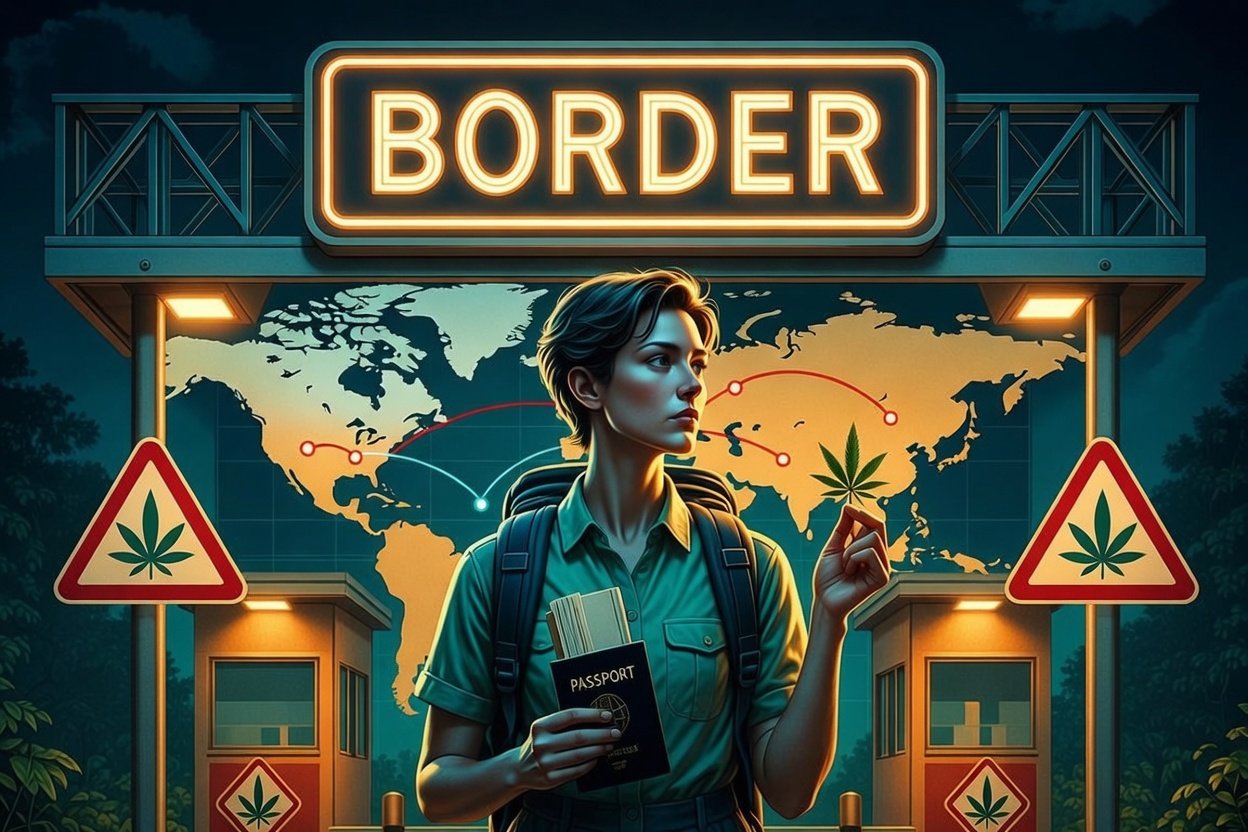
Why Every Journey Begins With Legal Awareness – From UN Treaties to Airport Security Protocols
The Global Legal Architecture That Shapes Every Traveller’s Reality
The first step in travelling with cannabis is deceptively simple: check the laws. Yet behind this seemingly straightforward instruction lies a dense web of international treaties, federal prohibitions, regional contradictions, and geopolitical risks that make cannabis one of the most legally volatile substances a traveller can carry.
The foundation of this volatility is the UN Single Convention on Narcotic Drugs (1961) – the treaty that still defines cannabis as a controlled substance. Despite national reforms, this classification creates a global legal baseline: cannabis possession remains criminalised in most jurisdictions, and cross-border transport is treated as trafficking.
When ‘Legal at Home’ Means Nothing Abroad – The Power of Federal Law
Cannabis may be legal in Canada, Uruguay, Malta, or dozens of US states, but federal law still governs borders:
- The TSA in the United States explicitly states that cannabis remains illegal under federal law, regardless of state legality.
- The CBSA in Canada warns that transporting cannabis across borders – even between two legal jurisdictions – is a federal crime.
This contradiction is not a bureaucratic quirk; it is a direct consequence of the UN treaty system. Countries cannot permit international cannabis transport without violating their treaty obligations, which is why border agencies enforce strict prohibitions even when domestic laws are liberal.
Europe’s Schengen Zone – Where Medical Cannabis Requires a Passport of Its Own
Europe adds another layer of complexity. In the Schengen Area, medical cannabis patients must obtain a Schengen Certificate – a formal document issued under Article 75 of the Schengen Convention, verified by multiple European health authorities and peer-reviewed legal research.
This certificate is the legal mechanism that allows controlled narcotic medications, including medical cannabis, to cross Schengen borders. It must be issued or authenticated by the competent health authority of the patient’s country of residence, specifies the medication name and dosage, and is valid for a maximum of 30 days. Without it, even legally prescribed cannabis is treated as contraband.
Key points patients must understand:
- Not all Schengen countries recognise medical cannabis equally. Germany and the Netherlands allow it under regulated conditions; France and Sweden restrict or do not fully recognise its medical use.
- Since April 2024, Germany reclassified medical cannabis as no longer a narcotic domestically – but patients travelling from Germany to other Schengen countries should still verify destination-country requirements and carry documentation.
- The certificate covers travel within Schengen only. Travel outside Schengen requires separate verification of each destination country’s laws.
The Transit Trap – When Airports Become Legal Minefields
The most dangerous misconception is believing that legality only matters at your origin and destination. Transit countries can impose severe penalties even if you never leave the airport.
- In the UAE, Singapore, and several Asian jurisdictions, trace amounts of THC or CBD can lead to detention or imprisonment.
- Thailand’s 2024-2025 re-regulation of cannabis created unpredictable enforcement for travellers who assumed 2022 rules still applied.
- Even emergency landings due to weather or mechanical issues can place travellers into jurisdictions where cannabis possession is a serious crime.
The arrest of American athlete Brittney Griner in Russia in 2022 – detained for carrying medically prescribed cannabis vape cartridges at a Moscow airport – became a defining example of how medical status carries no legal weight in prohibition-enforcing jurisdictions. She was sentenced to nine years before being released in a prisoner exchange in December 2022.
International Votes That Shape Today’s Policies
The global legal landscape is not static. On 2 December 2020, the UN Commission on Narcotic Drugs (CND) voted 27-25 to remove cannabis and cannabis resin from Schedule IV of the 1961 Convention – the category reserved for the most dangerous substances with no medical value.
This vote did not legalise cannabis internationally. But it formally acknowledged medical value and opened political space for national reforms. Schedule I classification remains, meaning cannabis is still treated as a controlled substance globally – and cross-border transport remains prohibited.
Why Checking Laws Is the First Step – Not an Afterthought
There is a universal truth: cannabis is the only consumer product that can be legal medicine in one country, a tolerated substance in another, and a cause for life imprisonment in a third.
This volatility makes legal verification the first – and most essential – step in any travel plan. The practical checklist for any medical cannabis patient travelling internationally:
- Obtain a Schengen Certificate if travelling within the Schengen Area, applied for well in advance.
- Confirm the destination country’s specific rules on imported medical cannabis – not just whether cannabis is legal there generally.
- Check every transit airport or stopover country, not just the final destination.
- Carry documentation in multiple languages if travelling across language borders.
- Never assume that legal status at home transfers across any border.
Conclusion – The Law Is the Map, Not the Obstacle
Travelling with cannabis is not impossible. But it demands respect for a global legal system still shaped by decades-old treaties, uneven reforms, and geopolitical tensions.
In a world where cannabis legality shifts by jurisdiction, preparation is the traveller’s only reliable protection. Knowledge of the law at every point of your journey – origin, transit, and destination – is the difference between a smooth journey and severe criminal consequences.