Latin America’s Cannabis Revolution: From Activism to Legislation
A Region Where Activism Meets International Law
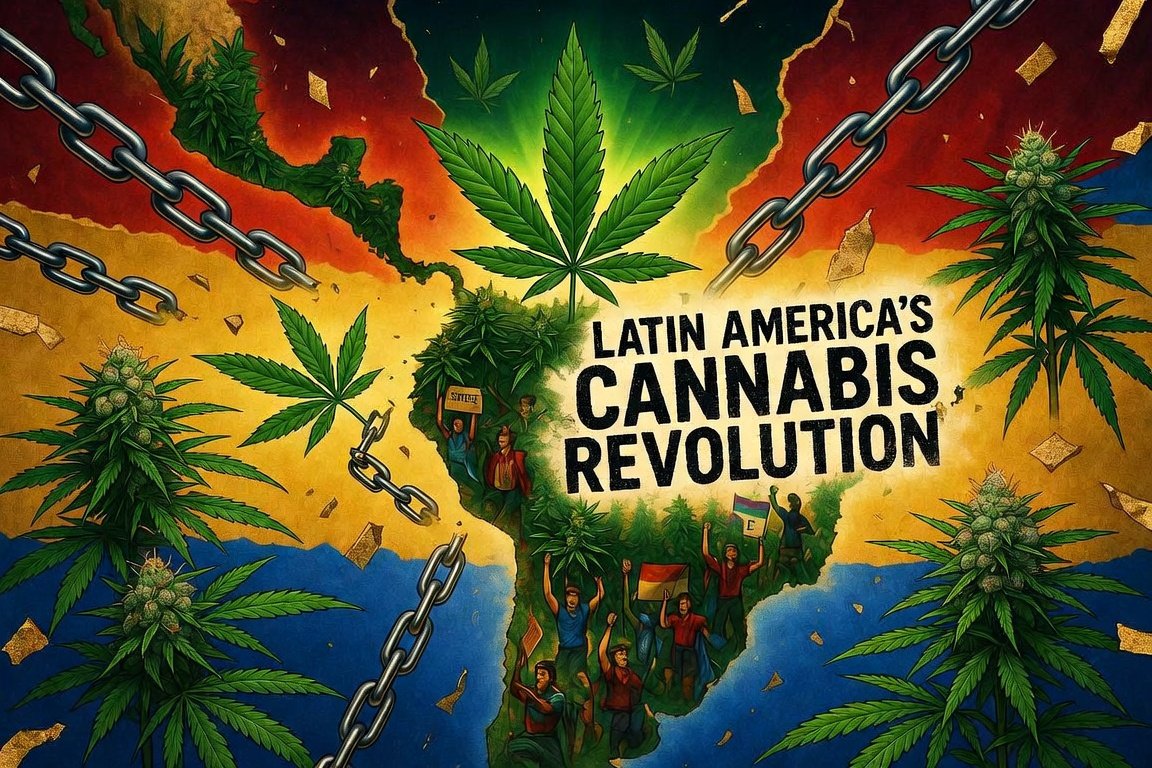
Latin America’s cannabis revolution did not begin in parliaments – it began in streets, courts, and human-rights movements. For decades, the region bore the heaviest scars of the global drug war. This historical trauma transformed it into the world’s most legally innovative landscape for drug policy reform.
Yet every reform must unfold under the rigid constraints of international law. The core UN drug control treaties still classify cannabis as a Schedule I controlled substance, obligating signatory states to criminalize non-medical production and trade. Consequently, Latin American governments face dual, opposing pressures: bottom-up activism demanding reform and top-down treaty obligations demanding prohibition.
The result is a geopolitical paradox. Instead of waiting for a slow consensus to rewrite international law, Latin American nations drive cannabis policy forward through radical constitutional interpretation, judicial rulings, and political courage – often in open tension with international bodies.
Finding Legal Pathways Around Prohibition
Rather than attempting to erase international agreements, Latin American jurists have elevated fundamental domestic principles – such as constitutional rights, human dignity, privacy, and public health – above punitive mandates. They use the inherent flexibility within global frameworks to justify domestic liberalization.
Uruguay: Breaking the Prohibition Paradigm
In 2013, Uruguay became the first country in the world to fully legalize and regulate adult-use cannabis. Under President José “Pepe” Mujica, the government openly acknowledged that its reform bypassed international treaty restrictions, arguing that human-rights and public-health priorities justified the deviation.
The Uruguayan model is a heavily regulated, state-controlled public health experiment built on five pillars:
- State control of production: Licensed private cultivation under tight state surveillance.
- Pharmacy-based distribution: Registered citizens buy a limited monthly quota at state-fixed prices to undercut the black market.
- Home cultivation: Up to six flowering plants per household.
- Cannabis clubs: Non-profit cooperatives for collective cultivation.
- Strict oversight: A total ban on advertising and mandatory registration.
Uruguay shattered the assumption that international treaties were immovable, opening political space for other nations to reconsider prohibition.
Colombia: Constitutional Rights as a Path to Reform
Colombia’s evolution is rooted in constitutional jurisprudence. The Constitutional Court has repeatedly ruled that personal cultivation, private consumption, and possession fall under the fundamental right to individual autonomy and the “free development of personality.” The judiciary argued that the state cannot criminally punish citizens for choices affecting only their own bodies. Leveraging this framework, Colombia legalized medical cannabis and created a regulated export industry, proving how constitutional rights can override international treaty-based prohibition.
Mexico: Supreme Court vs. Prohibition
In Mexico, the battleground shifted directly into the Supreme Court of Justice. Between 2015 and 2021, the Court issued five consecutive rulings declaring that cannabis prohibition violates the right to free personal development and privacy. Under Mexican law, this established a binding legal precedent, stripping the government of its authority to arrest individuals for personal use and forcing a reluctant Congress to draft legalization frameworks.
Argentina and Brazil: Human Rights and Judicial Pressure
Argentina expanded medical access by emphasizing patient rights, compassionate use, and research. The government framed the reform as consistent with the core UN drug control treaties, which explicitly allow cannabis for medical and scientific purposes, utilizing treaty flexibility rather than open defiance.
Conversely, Brazil’s legislature remains highly conservative. However, the Supreme Court is actively considering the decriminalization of personal possession. Medical expansion in Brazil has been driven by thousands of individual patient lawsuits. Courts routinely rule in favor of patients, ordering the state to fund imports or granting families protections to grow cannabis at home.
Incremental Regional Momentum
Chile, Peru, and Ecuador have adopted tailored, incremental models, including medical programmes, personal decriminalization, and limited cultivation rights. The 2020 UN vote removing cannabis from Schedule IV provided vital diplomatic justification for these governments to expand medical markets without appearing to violate global frameworks.
Reshaping Global Policy
Latin America has decentralised the authority of international drug policy. By demonstrating that constitutional rights can override global prohibitions, it offers diverse, citizen-centric alternatives to the commercialised systems of North America. The region did not wait for treaty reform; it forced the world to reconsider the boundaries of national sovereignty and human rights.